Home » Posts filed under Culture
Showing posts with label Culture. Show all posts
Showing posts with label Culture. Show all posts
Makanan, Minuman, dan Cemilan Khas Jepara

Makanan Khas Jepara
Pindang Serani
Makanan khas dari jepara adalah pindang serani. Pada gambar di atas ditunjukkan pada nomor 1. pindang serani ini biasanya menggunakan ikan bandeng sebagai bahan utamanya. Kuahnya yang bening terasa segar sekali di mulut. Lebih nikmat lagi jika disantap saat masih hangat. Pindang serani ini biasa terdapat di restoran tradisional yang ada di Jepara. Masakan pindang serani juga sudah menyebar ke seluruh plosok pulau jawa dan bisa ditemukan juga di rumah makan yang menyajikan menu masakan Jawa.
Makanan khas Jepara berikutnya adalah orog-orong. Makanan ini nyaris tidak bisa ditemukan selain di kota asalnya yaitu jepara. Makanan ini sudah populer sejak era gerakan tiga puluh September atau biasa disebut dengan “Gestapu” Partai Komunis Indonesia (PKI). Pada masa itu orog-orog merupakan salah satu kekayaan kuliner yang dimiliki oleh kota kelahiran R.A Kartini.
Horog-Horog
Horog-horog merupakan sejenis nasi hasil olahan dari bahan tepung aren. Pada gambar diatas ditunjukan pada nomor 2. Cara pembuatannya memang lumayan rumit dan memakan waktu yang cukup lama yakni hingga dua hari dua malam.
Diawali dengan pencucian tepung aren, pengeringan dibantu dengan taburan abu diatas adonan, pengerukan kemudian digoreng tanpa minyak. Selanjutnya, proses berikutnya merupakan pengulangan dari proses yang telah dilakukan sebelumnya. Pengulangan yang dilakukan selama dua kali pengukusan itu agar hasilnya terasa kenyal jika dimakan. Agar hasilnya terasa lebih lezat hanya cukup ditambahkan garam secukupnya.
Konon menurut legenda kemampuan yang dimiliki oleh pembuat horog-horog belum tentu bisa menghasilkan produk yang enak dinikmati. Sebab, lezat atau tidaknya hasil bergantung pada hati yang membuat. Keikhlasan hati pembuat horog-horog sangat menentukan kualitas produk sementara jika si pembuat sedang kesal atau marah maka produknya menjadi gagal.
Selain itu, pembuat juga harus bersih diri. Pembuat horog-horog hendaknya bersih secara fisik, khususnya tangan. Jika tangan masih menyisakan bau amis dan memaksakan untuk mengolahnya maka hasilnya akan cepat membusuk.
Kini, makanan yang bentuknya seperti busa steorofom yang kenyal dengan rasanya sedikit asin itu makin lama makin langka. Meski langka tetapi masih mudah untuk mendapatkannya. Jika anda adalah pelaku wisata kuliner mesti mencobanya. Sebab makanan itu di jual di pasar juga di warung.
Dengan mengeluarkan duit Rp.5.000 anda bisa mendapatkannya dengan wadah besar. Untuk ukuran yang kecil cukup dengan Rp.3.000. Adapula yang dibungkus dengan daun jati maupun dengan daun pisang dengan harga Rp.500 hingga Rp.1.000. Horog-horog enak dimakan dengan sambal pedas dicampur dengan kecap maupun saus. Enak juga jika dicampur dengan bakso maupun gado-gado.
Minuman Khas Jepara
Adon-Adon Coro
Pada gambar diatas ditunjukkan oleh nomor 3. Minuman adon-adon coro ini sangat nikmat apalagi bila disajikan dalam keadaan hangat. Selain nikmat minuman ini juga berkhasiat karena ramuannya mengandung
jahe dan rempah. Selain jahe dan rempah, ada irisan kecil-kecil buah
kelapa muda dan santan, sedangkan rasa manisnya diperoleh dari gula
jawa/merah.Jika ingin mencobanya silahkan datang ke Jepara ke warung-warung tradisional. Minuman adon-adon coro ini akan lebih mudah didapatka jika waktu sudah sore atau amalam hari. Pedagang biasanya menjual minuman ini di pinggir jalan, alun-alun atau di blakang Shoping Center Jepara (SCJ).
Cemilan Khas Jepara
Kacang Listrik
Kacang listrik adalah cemilan khas Jepara. Gambar 4. Karena untuk memanggangnya bisa juga menggunakan oven makan kacang listrik ini juga dikenal sebagai kacang oven. Kacang ini sudah menyebar kepenjuru Indonesia terutama pulau Jawa.
Pada mulanya cara memasak kacang listrik ini adalah dengan menyiapkan biji kacang yang masih terbungkus kulit ari kemudian diberi bumbu bawang putih dan garam lalu dikeringkan (diangin-angin). Kemudian digoreng dengan pasir putih sampai masak. Setelah itu, kacang dituang ke pasir setelah pasir dalam keadaan panas.
Durian Petruk Jepara
Asal nama Durian Petruk berasal dari pemilik alias penemu Durian Petruk yaitu Pak Petruk yang tinggal di Dukuh Randusari, Desa Tahunan Kecamatan Tahunan Kabupaten Jepara, Karena nama penemunya Pak Petruk maka dinamakan Durian Petruk.
Sentra penjualan durian di Jepara adalah Pasar Ngabul (7 km sebelum masuk kota Jepara dari arah Kudus). Tapi jika anda ingin menikmati buah durian sambil menikmati suasana pedesan, anda dapat membeli langsung kepada pemilik pohon yang tersebar hampir disemua desa di Kecamatan Tahunan, Bate Alit, Bate Gede, dan biasanya harganya lebih murah.
Perang Obor Jepara

Sesuai namanya, yaitu Perang Obor Tegalsambi, ritual tradisional di kegelapan malam ibarat perang api. Perang yang menjadi ciri khas Desa Tegalsambi Kabupaten Jepara ini akan berlangsung pada 28 Mei. Perang ini merupakan ritual kuno sejak awal abad ke-16.
Konon, perang obor dimulai oleh seorang tokoh desa bernama Kiai Babadan dan abdinya yang bernama Ki Gemblong. Ritual sedekah bumi diyakini untuk menghindari desa dari segala bala. Oleh karena itu, perang obor biasa dilakukan tergantung masa panen.
Obor yang digunakan sendiri terbuat dari pelepah dan daun kelapa yang sudah kering. Adu obor terus berlangsung sampai obor-obor habis. Luka bakar pun tak terhindari. Namun, uniknya, luka bakar dari peserta akibat bara bisa diobati dengan air bertuah yang diberikan tokoh adat setempat.
Ratu Kalinyamat Queen of Jepara

History
(Ratu Kalinyamat Queen Of Jepara)
After Sultan Trenggono was killed in his military expedition at Panarukam, East Java in 1546, there was a fighting for the throne of Demak Kingdom ceasing with Pangeran Parwoto death from Demak, followed by Pangeran Hadirin from Jepara and Pangeran
Aryo Penangsang from Jipan Panolan.
After this crisis ceased, Ratu Kalinyamat appeared as the ruler of Jepara and Pangeran Hadiwijaya at Pajang in 1549. Whereas both figures identities, that was Ratu Kalinyamat was the daughter of Sultan Trenggono and also the wife of Pangeran Hadirin, while Pangeran Hadiwijaya was the son in law of Sultan Trenggono as well.
During Ratu Kalinyamat’s authority, Jepara quickly developed became the main commercial port which was served export import activities in Javanese island. Moreover, Jepara became the marine force center which had been existed since Demak Kingdom.
As a ruler for prosperous Jepara because of its existence for the crowded commercial port, Ratu Kalinyamat was famous with her patriotism spirit and anti-colonialism. It was proved by sending her combat fleet for Malacca to attack and destroy Portuguese in 1551 and 1574. It was not excessive if Portuguese called her as “ De Krange Dame”, meaning “ A Grave-Strong Women”, or “De Couto” and a Portuguese writer in the book “Da Asia” called her as “Rainha De Jepara, Senora Pade Rosa De Rica”, meaning the Queen of Jepara with her power and prosperity.
Ratu Kalinyamat’s brave strong aggression involved almost 40 ships with more than 5.000 warriors failed completely when Kalinyamat’s warriors attacked land in order to encircle Portuguese port in Malacca. The Portuguese warriors with complete arms were successfully break Kalinyamat’s encircling warriors. However, the Queen’s patriotism was never faded and bravely against colonialism who were in their top supremacy and admitted as the boldest people in the world.
Twenty four years later or exactly in October 1574, Ratu Kalinyamat sent bigger military fleet to Malacca. The second military expedition involved 300 ships with 80 ships of great jung assembled by 15,000 superlative crews. The second military fleet shipment was late by the prominent commander in the kingdom called “Quillimo” by the Portuguese. Though the second war ran monthly, Kalinyamat’s warriors could not drive Portuguese away from Malacca. However, it made Portuguese afraid and reluctant to confront the Queen of Jepara. It was proved by the Javanese sovereignty from the colonialism of Portuguese in the 16th century. As a relic based on the Great War between Jepara and Portuguese, until this time there is grave complex in Malacca called Makam Tentara Jawa (Javanese Warrior Grave).
Moreover, Ratu Kalinyamat has a great contribution in enculturating wood carving which is noe become the highest contribution for economic in Jepara. Its motive is Majapahit wood carved motive mixed with Chinese motive, since Pangeran Hadirin used to study there.
According to Jepara’s history, Ratu Kalinyamat was died in 1579 and buried in Mantingan, Jepara, beside her husband grave, Pangeran Hadirin. Referring to all positive aspects as verified by Ratu Kalinyamat, Jepara became a prosperous, strong and famous country. The settlement of Jepara anniversary exactly on April 10th 1549 was based on Ratu Kalinyamat inaugurating day as the Jepara ruler.
Mithology
Jeparanese people believe that after Pangeran Hadirin had been killed by Arya Penangsang’s people, Ratu Kalinyamat, the most beautiful woman in har time, then meditated nakedly at Mount Danaraja. She made an oath that she would never get dressed before Aryo Penangsang died. Some people also said that she had an ally with Nyi Roro Kidul, the mythological Queen of Southern Sea. They made such kind of treaty so that Nyi Roro Kidul would help Ratu Kalinyamat take revenge.
This mythological believe has made Mount Danaraja become famous as magical place. People in Jepara also made this story as a sacred thing and they, especially the old, are a rather afraid of talking about this subject. However, the do honour Ratu Kalinyamat and consider her as the greatest female figure of Jepara, even more than that of R. A. Kartini.
I believe that Ratu Kalinyamat is such an influential female figure in her time. Firstly, is because in 1500s when Indonesia had not existed and women were considered as weak creatures and respected less than men, she came up as a leader of a prosperous and wealthy area. She was very brave, even when not all male leaders were, sending her warriors to fight against Portuguese in Malacca. She even did this twice.
The second thing is that her innovation of developing mixed Chinese-Majapahit motive batik as the biggest commodity of Jepara had led the area to be prosperous. This batik motive is still the biggest commodity of Jepara and is still the special motive of Jepara that no other regions have.
This can inspire us, especially young women generations to do more to our country and be tough women that can stand up whatever bad things that happen to us.
Welahan Temple - Pagoda “Hian Thian Siang Tee”
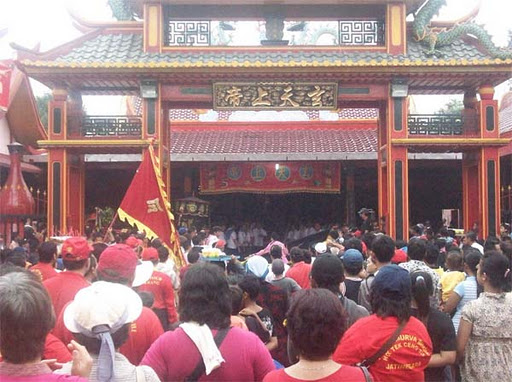
Temple or klenteng Welahan 'Hian Thian Siang Tee' or HTST. Placed in village/sub-district Welahan, Jepara Regency. It is located 24 km south of Jepara city center, exactly at Welahan village, Welahan Sub-district, Jepara District, a village with ancient Chinese heirloom and becoming one of the historic tourism assets in Jepara, where strongly standing two pagodas built by a Chinese traditional healer named Tan Siang Boe together with his elder brother named Tan siang Djie. Visiting for this tourism historic object, some asphalted road or infrastructure through which tourists can pass by and get on 2-wheeled or 4-wheeled vehicles or many other public transports, as the location is nearby Welahan traditional market.
HISTORY AND LEGEND
In 1830 the Dutch General Governor, Johanes Graaf Bosch reigning Indonesia, which was called as the Netherlands Indies Colonization at that time coming a Chinese from China called Tan Siang Boe. His leaving from China to Southeat Asia was to find his elder brother named Tan Siang Djie in Indonesia. Leaving from China together in one boat was a Tasugagu who had meditated from Pho To San at Cinese land, as a meditative place of his excellency minister / emperor Hian Thiam Siang Tee during his trip and falling in sick, than with his solidarity and sympathy among people, Tan Siang Boe treated him with his medicines brought with from China, than he could cure Tasugagu’s sickness.
Gratefully for his treatment, while landing at Singapore, Tasu provided a gift in his express of thanks to Tan Siang Boe in the form of a bag with Tionggoan heirloom consisting of : a piece of Sien Tjhiang (smooth paper painted with His Excellency Hian Siang Tee), a stick of pokian (a Chinese sword), a Hio Lauw (place for dust from cremation), and a Tjioe Hwat (a book of medicine / forecast). After Tan Siang Boe arrived at Semarang, overnight staying in Kong Kwan’s group house where he got an information that his elder brother was in Welahan Jepara,
so he left for meeting Tan Siang Djie, his elder brother living together in a house with Liem Tjoe Tien’s family.This house is located at a gangway along side Welahan and now used for keeping the heirloom called Pagoda as a place for praying and respected by each Chinese believing in. After some time ago, Tian Siang Boe staying with his elder brother in Welahan, once upon a time, he went to work for another place.
In that case, the heirloom were entrustede to his elder brother considering that it was necessary to save the heirloom, so Tan Tjoe Tien entrusted the heirloom to the house owner, Liem Tjoe Tien, who always kept the heirloom up the balcony of his house. At that time, in general, he did not know what heirloomit was kept up the balcony.
During the storage up the balcony, every 3rd of Sha Gwa’s birth, i.e., Imlek of Seng Tan Djiet from Hian Thiam Siang Tee, the heirloom sparked a magic power like sparkling-out fire, sometime like a very marvelous fire-dragon and turtle that made the house settlers gor surprised. This event made him to call back Tan Siang Boe, the entrustee of the heirloom to Welahan to open the heirloom kept in the bag up the balcony. Opening and showing the heirloom to the members of the house settlers, he said that the heirloom were the relic from His Excellency Hian Thiam Siang Tee, so since then, the heirloom were praised according to the ancestor’s custom and tradition.
One day, Liem Tjoe Tian fallen in hard sickand it could be recovered by the magic power of the heirloom. With this event, mouth-to-mouth talk by people made the power famous, respected and praised among people believing in till now.Accordingly, the only heirloom of ancient Chinese for the first time coming into Indonesia as brought by Tan Siang Boe is that kept at Welahan, so it is believed that the existence of Welahan pagoda is the oldest one in Indonesia.With this existence of pagoda in Welahan, not only dominated by Chinese ethnic, but alsonatives coming frommany cities or peovinces asking for treatment, destiny, partners, planting and advancement in bussines, etc.
Traditional ceremony "Perang Obor"

The traditional ceremony Perang Obor, which is per formed at Pahing Monday in the night of Pon Tuesday in the month of Dzulhijah every year, it is held by the tegal Sambi villagers basic faith of the past event happened in the village.It is said that in the 16th century there was a rich farmer named Mbah Kyai Babadan in Tegal Sambi village. He has a lot of cattle, especially buffalo and cow.
IIt was impossible for him to look after the castle by himself, so he looked for and got a shepherd named Ki Gemblong. Ki Gemblong was very diligent in looking after those animals. He bathed them in a river every morning and evening, consequently the cattle grew healthy and fat. Kyai Babadan felt so happy and flattered Ki Gemblong for his diligence and obedience in tacking after the cattle.
One day, Ki Gemblong was looking after cattle in a river side of Kembangan when he saw many fish and shrimps in the river. Without waiting any longer, he caught the fish and shrimps, cooked and ate them in stable.
The traditional ceremony “Obor-oboran” is one of traditional ceremonies owned by the society of Jepara regency, especially Tegal Sambi vilagge Tahunan district, which is the only one in Central Java and maybe in Indonesia.
Torch (obor) in the ceremony is made by two or three roll of banana mid-rit and filled with dry leaves of banana (Javanese: klaras)
The prepared torches are burnt together in order to be used as attacker. The bumped torches make a big red hot, eventually people call it “ Perang Obor” (Torch War ).After that Ki Gemblong caught the fish and shrimps almost everyday. He forgot about his duty as a shepherd. As the result, the buffaloes and cows become weak and sick even death. This condition made Kyai babadan confused. He tried to heal his cattle by magic formulas but it didn’t work.
Finally Kyai Babadan found out the reason why his cattle become weak and sick. It was because Ki Gemblong liked to catch some fish and shrimps to be cooked and eaten more than looked after those animals.
Kyai Babadan was so angry. Finding Ki Gemblong cooked the fish, Kyai Babadan hit Ki Gemblong with a torch made by coconut palm. Ki Gemblong also took the some torch to face Kyai Babadan.
The torch war finally began. The fire from the torch spread everywhere and burnt up stubble next to the stable. The fire made the buffaloes and cows run away and unexpectedly the sick animals healed even where able to stand upright and ate in the field.
Tegalsambi villagers finally accepted the unexpected and amazing event as a miracle, that by the torch war all disease would be healed.
Nowadays, the traditional ceremony “Perang Obor” in used as away of sedekah bumi, (as) an expression of thanks to god for his mercy to the Tegalsambi villager. The ceremony is held once a year
History of Carving, Sculpting and Jepara Furniture

Narrated an expert on sculpture and painting named Prabangkara who lived during King of the Kingdom of Majapahit UB, at one time the king sent Prabangkara to paint the king's consort as an expression of his love for the queen a very beautiful and fascinating.
Painting the empress without clothes that can be solved by Prabangkara perfectly and of course this makes the King UB became suspicious because on certain body parts, and secret there is a natural sign / that there are also specialized in painting and the place / position and shape exactly. By a ruse, Prabangkara with all the equipment disposed of in a way tied to a kite that after the laying-up in the sky cut the rope.
In these circumstances hovering Prabangkara chisel fell in a village known as the Back Mountain near the town of Jepara. In the small village north of the town of Jepara is until now there are many highly qualified craftsmen carving. But the origin of the engraving here whether it is correct due to the fall chisel Prabangkara, there are no historical data to support it.
1. In the reign of Queen Kalinyamat, there is a duke named Sungging Badarduwung from Campa (Cambodia) turned out to sculpt an expert anyway. Until now the duke's work can still be seen at the Old Mosque and Mausoleum complex Kalinyamat Queen was built in XVI century.
2. The collapse of the Majapahit Kingdom has led to the spread of Hindu scholars and artists to different areas of the first half of the XVI century. In the development, these artists continue to develop her skills by adjusting the identity in the new area so timbulah various regional motifs such as: Motives Majapahit, Balinese, Mataram, Pajajaran, and Jepara that developed in Jepara until now.
Search This Blog
Labels
Adventure
(10)
Beach
(4)
Culinary
(7)
Culture
(6)
football club
(1)
Handicrafts
(5)
History
(7)
Hotels
(7)
Islands
(3)
Museum
(1)
News
(11)
Population
(3)
RA Kartini
(1)
Restaurants
(8)
Tourism
(14)
Tranportation
(2)


